

 Welcome to Indo Science Accademy, Admisions 2026-27 now open !


1. The End of 10+2 (Say Hello to 5+3+3+4)
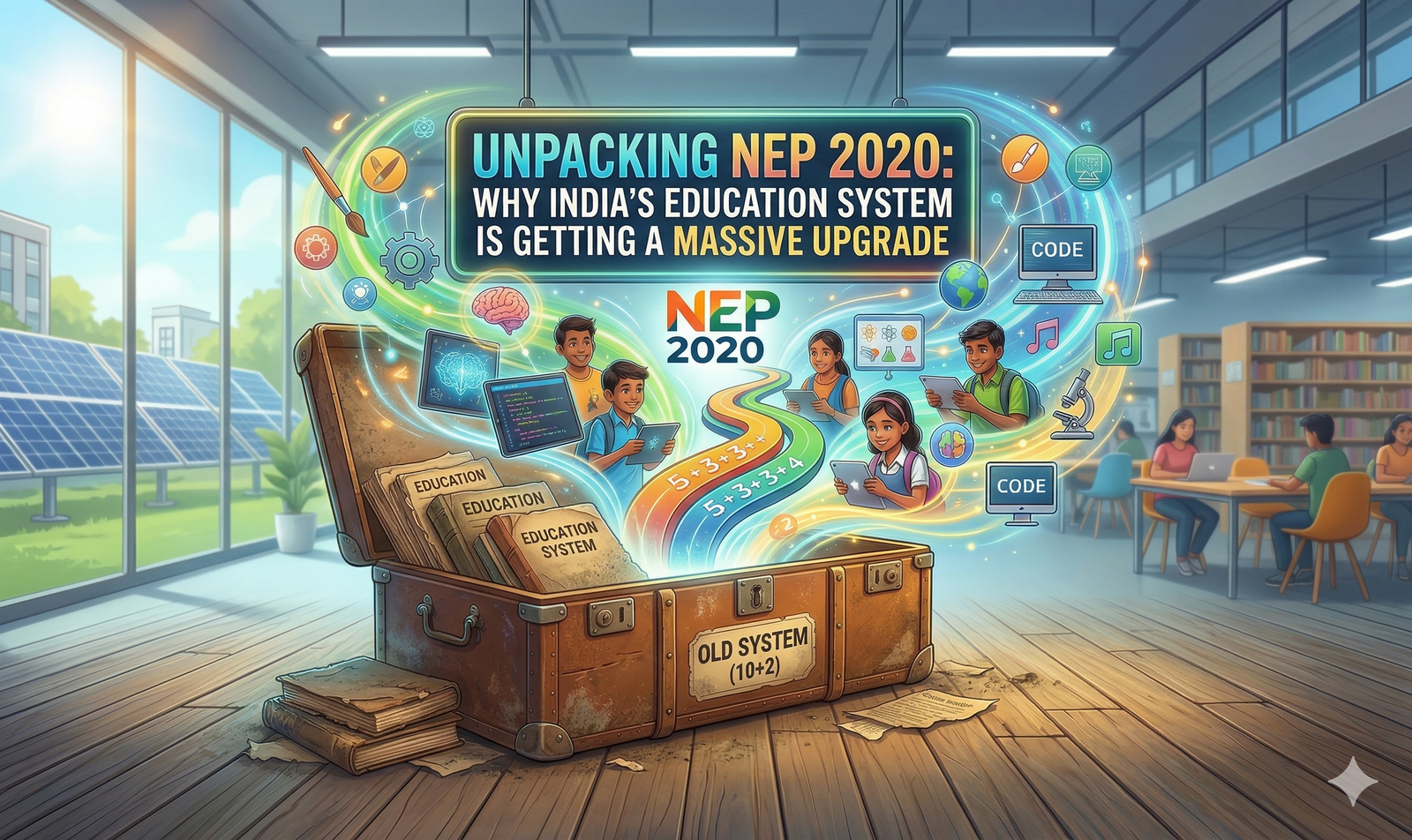
Perhaps the most visually striking change is the restructuring of school years. The traditional 10+2 board exam system is being replaced by a 5+3+3+4 curricular structure corresponding to ages 3-8, 8-11, 11-14, and 14-18 years respectively.
- Foundational Stage (5 years): Focuses on play-based and activity-based learning. Crucially, it brings preschool/Anganwadi into the formal education fold.
- Preparatory Stage (3 years): Introduces basic reading, writing, speaking, physical education, art, languages, science, and mathematics.
- Middle Stage (3 years): Introduces abstract concepts in sciences, mathematics, arts, social sciences, and humanities.
- Secondary Stage (4 years): Focuses on multidisciplinary study, critical thinking, and flexibility in subject choices.
2. Death to Rote Learning
We've all been there—cramming the night before an exam only to forget it all a week later. NEP 2020 is a declaration of war on rote learning. The focus is shifting entirely to competency-based education. This means exams will test core concepts, critical thinking, and problem-solving skills rather than sheer memorization.
3. Blurring the Lines Between Streams
Are you a physics nerd who also loves baking and history? Under the old system, you had to choose. NEP 2020 eliminates the rigid separation between Arts, Science, and Commerce. It also blurs the lines between vocational and academic streams. Vocational education (like coding, carpentry, or pottery) will start in school from Grade 6, complete with internships!
The Takeaway NEP 2020 is incredibly ambitious. It visualizes an education system rooted in Indian ethos that contributes directly to transforming India into an equitable and vibrant knowledge society. The real challenge, as with all great policies, will be in its execution. But for the first time in a long time, the blueprint looks incredibly promising.